
Purpose-driven organizations are in a crisis of accountability — and it’s structural
We see it as a burnout epidemic, internal trust issues, culture challenges, turnover, leadership overwhelm, blame and finger-pointing, depletion of resources on internal issues, and disconnection between leaders and staff. But these are the symptoms of Structural Accountability gaps, not the underlying cause, and none of these problems can be solved in isolation.
This is why point-solutions — a new HR policy, a staff retreat, a DEI training, a strategic plan, a new project management tool — don’t have the lasting impact we hope they will: because the underlying structural conditions remain the same. These tactics will only work when the accountability relationships underneath them are strong enough to hold the change.
What is Structural Accountability?
Purpose [WHAT & WHY] = the organization’s mission, stated objectives, long-term vision, values, and intended impact
People [WHO] = the people working for the organization (including executive leaders, senior leaders, managers, staff, interns, volunteers, board members, etc.), the people the organization serves, and the people the organization partners with (including other organizations and funders)
Systems [HOW] = the mechanisms by which the organization’s work is accomplished, including decision-making processes, technology platforms, fundraising campaigns, program operations, etc.
Structural Accountability in purpose-driven organizations is created when the entity is set up to reliably produce mutual accountability among colleagues at all levels, as well as creating accountability between the Purpose, the People, and the Systems of the organization. It is a way to think about improving organizational health by examining and strengthening the accountability relationships between these three core areas:
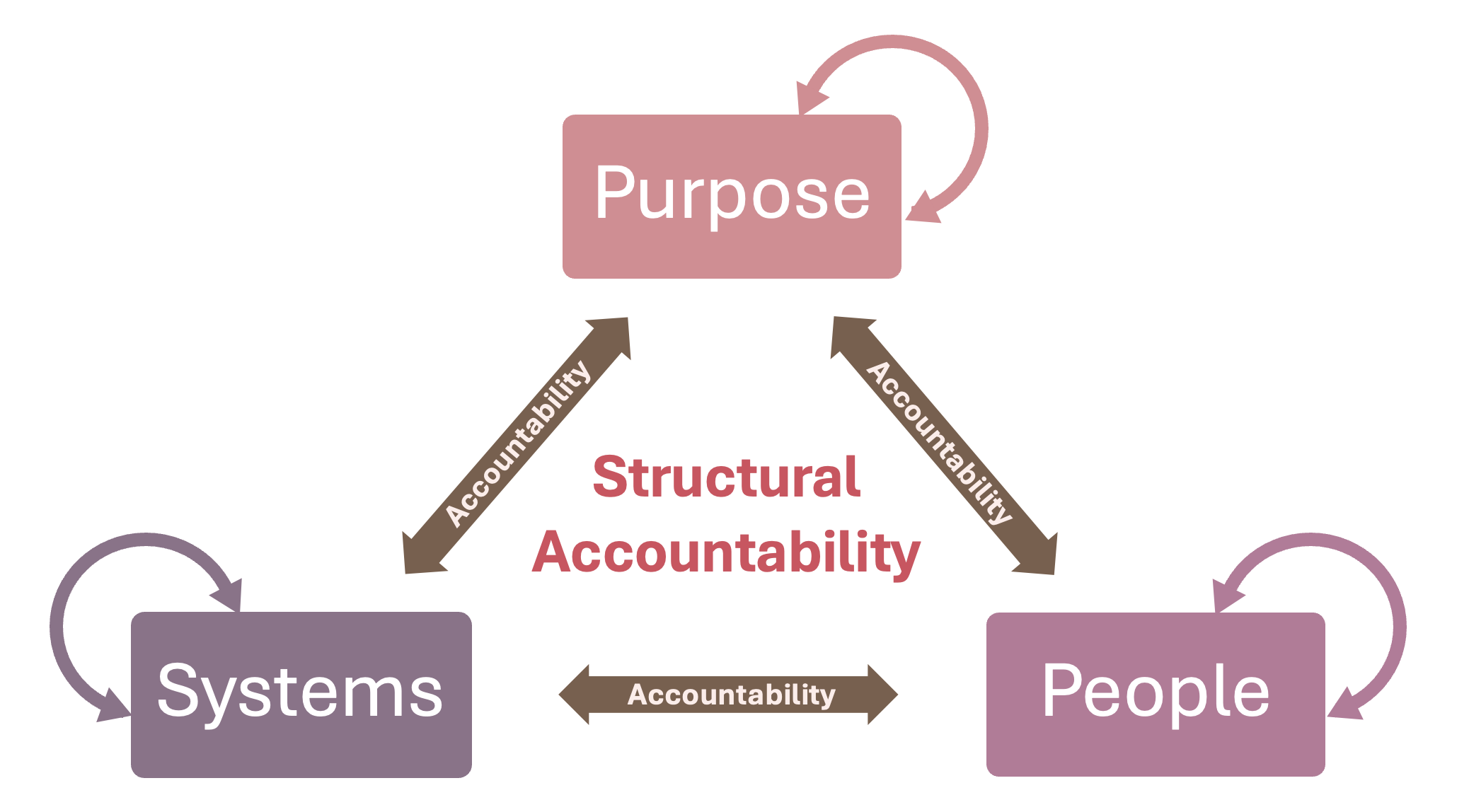
Accountability is ultimately about relationships: the relationships between people and – when we’re talking structurally – also the relationships between the areas that make it possible for an organization to fulfill its purpose. The people are in constant relationship with each other, with the systems of the organization, and with the organization’s reason for existing (i.e. purpose). Structural accountability makes these relationships strong and keeps them organized by values and integrity. However, it requires the right structures to create the conditions for relationships to function this way. That relationship-focused structure is Relational Infrastructure. If structural accountability is the blueprint, then relational infrastructure is the framing – the beams, rafters, slabs, and joists that hold the whole structure together. That’s because when it comes to delivering on the organization’s purpose, relationships are load-bearing, and they need the right structure to support them.
Accountability becomes structural when it exists between the core functions of the organization, not just between the people. It is not an individual success or failing, it’s an institutional one.
If, as Cornel West says, justice is what love looks like in public, then accountability is what love looks like at work.
Relational infrastructure (RI) is an emerging term that describes the foundational system of structures, processes, and conditions that shape how people connect, coordinate, and work together within an organization, network, group, or other entity. It is what makes work work — the designable architecture that determines whether the group's people can function effectively, trust each other, and direct their energy toward their shared goals rather than internal friction. Sam Rye, a social innovation and systems-change practitioner in Australia, offers the following working definition of Relational Infrastructure:
“Relational infrastructure refers to the social connections, interactions, and collective intelligence that underpin a community, network or group's ability to collaborate, solve problems, and drive change. It is an emergent framework of trust, shared values, and common goals that allows individuals, groups, and organizations to work together effectively, pool their resources, and amplify their impact. A strong relational infrastructure can enable organisations and communities to overcome challenges, build resilience, and create sustainable social, economic, and environmental value and outcomes.”
The right relational infrastructure makes it as easy as possible for strong, accountable relationships to form and flourish among the organization’s people and between Purpose, Systems, and People. It also makes it as hard as possible for these relationships to deteriorate or slide into dysfunction. Strong relational infrastructure does not mean everyone is happy all the time. It means that when hard things happen — as they always do — there are structures, relationships, and norms in place to navigate them well. And, in a virtuous cycle, the process of navigating them well further strengthens relational infrastructure. The outlier disappointments and challenges become exceptions rather than the defining experience within the organization, and the benefits are felt internally and externally.
When relational infrastructure creates strong structural accountability, organizations experience a set of conditions that make mission delivery not just more possible, but more sustainable – and even joyful:
Leaders are putting out fewer fires, feel more supported by their teams, and are able to direct resources more strategically
Staff can do their best work without expending significant energy on self-protection, navigating opacity, or managing the relational fallout of poor management
Decision-makers are accountable not just on paper but in practice: decisions are explained, commitments are kept, and standards apply consistently
People can raise concerns, name problems, and offer dissenting views without fear of retaliation, making the organization more adaptive, innovative, and credible
Turnover decreases, and institutional knowledge, relationships, and trust accumulate over time rather than cycling out with each departing staff member
The organization's external relationships – with the communities it serves, peer organizations, and funders – benefit from the credibility and capacity that come with internal stability