
Structural Accountability Framework
Purpose-driven organizations are in a crisis of accountability — and it’s structural. We see it as a burnout epidemic, internal trust issues, culture challenges, turnover, leadership overwhelm, blame and finger-pointing, depletion of resources on internal issues, and disconnection between leaders and staff. But these are the symptoms of Structural Accountability gaps, not the underlying cause, and none of these problems can be solved in isolation.
This is why point-solutions — a new HR policy, a staff retreat, a DEI training, a strategic plan, a new project management tool — don’t have the lasting impact we hope they will: because the underlying structural conditions remain the same. These tactics will only work when the accountability relationships underneath them are strong enough to hold the change.
What is Structural Accountability?
Purpose [WHAT & WHY] = the organization’s mission, stated objectives, long-term vision, values, and intended impact
People [WHO] = the people working for the organization (including executive leaders, senior leaders, managers, staff, interns, volunteers, board members, etc.), the people the organization serves, and the people the organization partners with (including other organizations and funders)
Systems [HOW] = the mechanisms by which the organization’s work is accomplished, including decision-making processes, technology platforms, fundraising campaigns, program operations, etc.
Structural Accountability (SA) is a way to understand and improve organizational health by examining and strengthening the accountability relationships within and between three core areas of any organization:
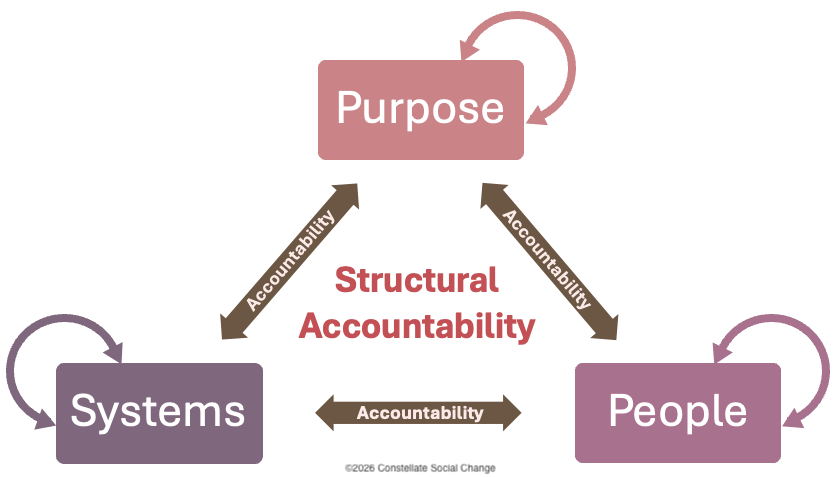
Structural Accountability is the practice of recognizing, formalizing, and resourcing the interdependence that already exists in mission-driven organizations. It goes beyond people being accountable to one another to include all the ways an organization builds accountability within and between its three interdependent components: Purpose, People, and Systems. When done well, it isn't punitive or reactive; it proactively shapes the organization's conditions so that being accountable is the path of least resistance, and avoiding it is the harder choice. It operates by design rather than by individual effort, shaping conditions so that accountability is the default, not the painful reckoning after something goes wrong.
When accountability is absent or only individualized – that is, only seeing accountability as an individual’s action or failure, either in being accountable themselves or holding others accountable – staff and leaders alike end up unhappy, burned out, distrustful of colleagues, and leaving for other jobs. And sometimes they leave the industry altogether.
If, as Cornel West says, justice is what love looks like in public, then accountability is what love looks like at work.
Crucially, Structural Accountability also makes racial, gender, and economic equity real within the organization. When Purpose, People, and Systems are accountable to each other (and within themselves), the organization operates with integrity, according to its values, and with a deep sense of mutual responsibility for making the organization work well, which includes doing right by the people in it. Equity, accessibility, justice, diversity, and inclusion are a result of strong structural accountability in an organization.
About the Framework
Accountability becomes structural when it exists within and between the core functions of the organization, not just on an interpersonal level. It is not an individual success or failing, it’s an institutional one. Because it’s structural, not just individual, SA shifts organizations out of blame and finger-pointing and into designing better systems, processes, and ways of working together. When it’s no longer about whether an individual is wrong or bad, it’s easier to see possibilities for collective solutions.
In this framework, an organization’s people, systems, and purpose are structurally accountable when they behave (people), are built (systems), or are organized (purpose) such that they:
reflect an accurate understanding of their impact on other people, systems, or purpose components;
account for and demonstrate respect for this impact in large and small daily ways of working;
can easily receive feedback and/or signals that improvements are needed;
create and/or enable repair when harm or misalignment occurs; and,
can adjust when evidence shows that the current state is not working.
Purpose Accountabilities
People within an organization need their organization’s mission, vision, and values to give them direction, inspiration, and purpose. The purpose grounds the work, it creates meaning and satisfaction, and it shapes how people think about their role in the world. People external to the organization need grounding in purpose as well to feel clear about what the organization exists to do, and to be able to connect to it, whether through services, donation, partnership, or other form of engagement.
-
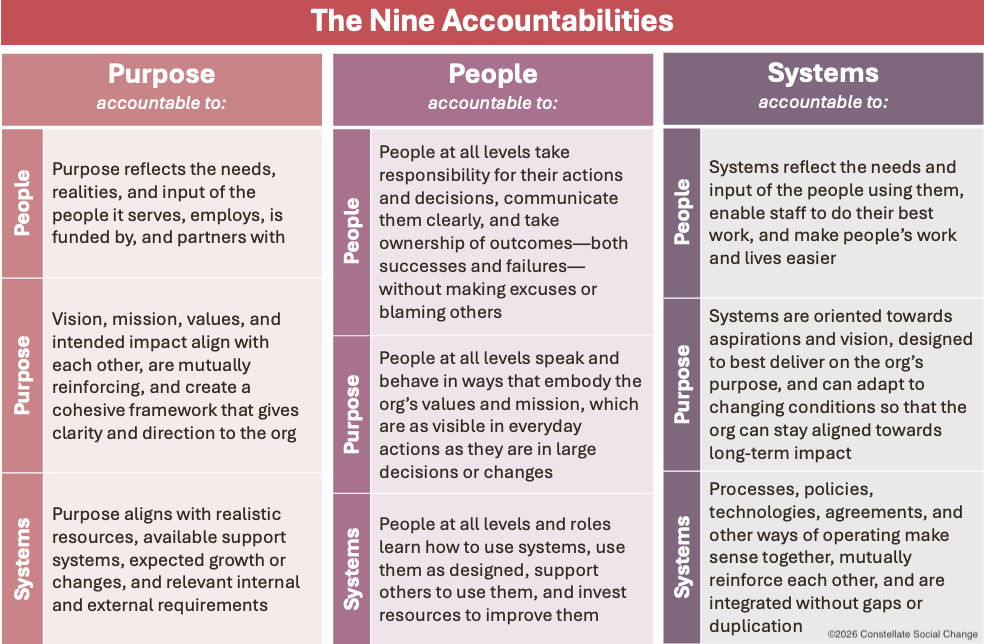
The Purpose is accountable to itself when the vision, mission, values, and intended impact align with each other, are mutually reinforcing, and create a cohesive framework that gives clarity and direction to the organization.
-
The purpose is accountable to the people when the components of the purpose category, described above, reflect the needs, realities, and input of the people it serves, employs, funds or is funded by, and partners with.
-
The purpose is accountable to the systems when the components of the purpose category align with realistic resources, available support systems, expected growth or changes, and relevant internal and external requirements.
People Accountabilities
People carry particular importance for structural accountability because even in the accountability relationships involving Purpose and Systems, the people are designing and using the systems and creating and implementing the purpose – and bearing the brunt of the harm caused when accountability is absent. In this framework, “People” is about the structural actors — roles, groups, constituents — more than unique individuals.
-
Structural Accountability between People is visible when, by default, people at all levels take responsibility for their actions and decisions, communicate them clearly, and take ownership of outcomes – both successes and failures – without making excuses or blaming others.
-
Structural accountability is present in this relationship when people in every role speak and behave in ways that embody the organization’s values and purpose, which are as visible in everyday actions as they are in large decisions or changes.
-
When this relationship is strong, people in every role learn how to use systems relevant to them, use them as designed, support others to use them, and invest resources to improve them.
Systems Accountabilities
If the people are the heart of the organization, Systems make up the rest of the body. These include all of the processes and repeated practices that make up the “how” of the work, including financial systems, program processes, governance procedures, etc. Limitations will always exist; systems accountabilities are as relevant in a resource-constrained environment as they are in a resource-abundant one.
-
Systems are accountable to Systems when processes, policies, technologies, agreements, and other ways of operating make sense together, mutually reinforce each other, and are integrated without gaps or duplication.
-
Systems are accountable to People when they reflect the needs and input of the people using them, enable staff to do their best work, and make people’s work and lives easier.
-
Systems are oriented towards aspirations and vision, designed to best deliver on the organization’s purpose, and can adapt to changing conditions so that the organization can stay aligned towards long-term impact. Often, however, systems don’t enact the larger purpose of the organization – and sometimes even work against it, causing harm to the organization and its ability to fulfill its mission.
This framework is designed for mission-driven organizations that are experiencing recurring trust, culture, burnout, decision-making, leadership, or systems challenges that have not been solved through isolated interventions such as retreats, new policies, DEI trainings, strategic plans, or staff engagement initiatives. Structural Accountability is not a culture framework, though it affects culture. It is not an HR framework, though it includes people systems. It is not a DEI framework, though equity is one of its necessary outcomes. It is not a strategic planning model, though it helps ensure strategy is accountable to people, systems, and purpose.
Constellate uses this framework in all engagements, helping client organizations, regardless of their entry point, shift the underlying conditions that give rise to these internal challenges and create stronger, more resilient organizations.